Showing posts with label accessibility. Show all posts

Monday, July 24, 2023

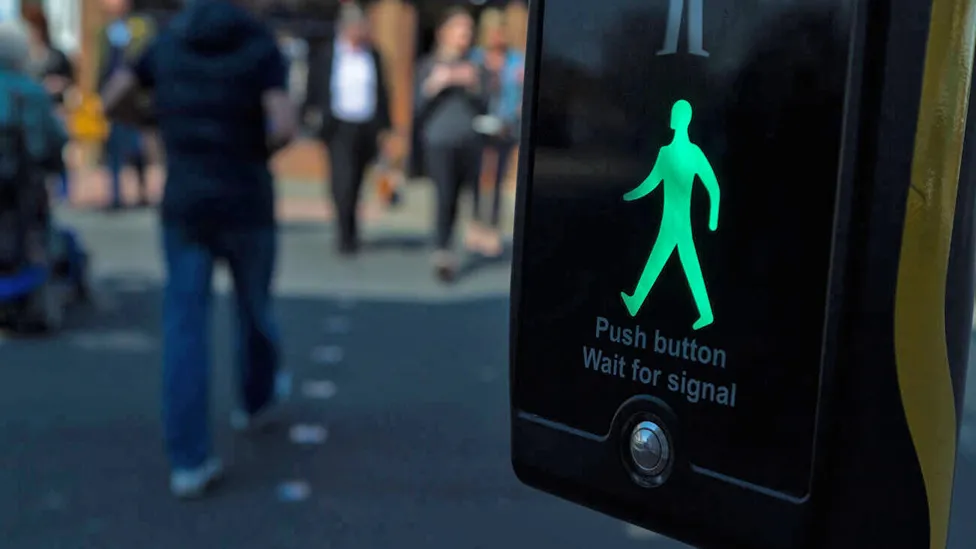
Green Man could stay on for longer at pedestrian crossings in England

I'm pleased to see that the length of time given for someone to cross a road at pedestrian crossings in the UK is to be increased. I walk pretty fast most of the time but even I have difficulty completing crossing the road in time in certain places. When my Mum was alive and aging, she had no chance of crossing the road in the time allotted and we had to hope that drivers would be kind and let us pass. That did mean she restricted where she went on her own and the routes she took in order to reduce the number of main roads she needed to cross.

However, there seems to me to be a flaw in the equation. Research shows that the more densely populated a place is, the quicker they tend to walk. Therefore the average walking speed in Worcester will be different from the walking speed in London. Not only that, but some places will have a higher proportion of people in their vicinity who are less mobile due to age or illness. I hope, therefore, that there will be local nuance in the decisions made.

It may seem like very trivial news to some, but it has the potential to make our streets more accessible to those who walk the most.

https://www.bbc.co.uk/news/uk-politics-66292145

Monday, May 18, 2015

Learn about Accessibility in London on Thursday

Yes, it’s short notice, but one of the speakers of my accessibility sessions from a few year’s back is having an open learning day on Thursday 21st May at his company’s offices in East London.

Professor Jonathan Hassell and Christine Hemphill are the founders of Open Inclusion which is a digital accessibility, US and innovation consultancy. They help clients make beautifully inclusive products – better by design, for better user experiences for all and better business.

Jonathan impressed me with his knowledge and engaging way of sharing that knowledge in the session he did for me all that time ago. That’s why I’m sure his Global Accessibility Awareness Day sessions will be well worth attending. And not only that, they’re free to attend. You can pick and choose which sessions you want to attend. The action starts at 11am and goes on throughout the day covering a variety of topics related to accessibility and design.

More information and RSVP here.

More about Open Inclusion and the work they do here.

Wednesday, January 23, 2013

None of us are getting any younger

Which means that us younger ones have a duty to create the digital future we want for ourselves. As we get older, our faculties inevitably decline. I have already noticed my hearing and my eyesight isn’t as good as it was and I still consider myself young. It’s just a fact of life. No-one else is going to create this future for us, or if they do, we may not like it, so we have to get on with it ourselves. And there hasn’t been a better time to do this. The barriers to entry haven’t been lower, access to technology is easier, we all have smartphones or tablets or both and they’re getting cheaper, and now, organisations like IC Tomorrow is helping fund the prototyping of some new ideas too.

They recently held a call for entries for their Digital Inclusion Innovation Contest in three specific areas – Sensory Assistance, inclusive media and accessible internet of things. The finalists have been chosen and they’ll be presenting at the final to be held on Thursday 7th February in London. Tickets are free and can be booked here. The contest is in collaboration with the Royal National Institute for Blind People (RNIB) and the National Licensing Agency (NLA), University of York and Scope

The following companies will be presenting at the event:

Sensory Assistance – using smart phones to assist older people and people with sensory disabilities. Partner: University of York

· Georgie Last 10 Yards by Screenreader.net CIC

· Mobile-phone assisted navigation for visually impaired people by Spiral Scratch

· Tribble Doorbell Alerts by Novoda (video entry below)

Inclusive Media – creating a new digital reader and search tool for newspapers and magazines. Partners: RNIB & NLA

· Matopy, the app that makes newspapers and magazines truly interactive by Matopy

· Georgie Bookreader by Screenreader.net CIC

· NewsReader by Assistive Solutions

Accessible Internet of Things – enhancing physical home functions for disabled people. Partner: Scope

· The Smart Hub by Therapy Box

· StarInterface by National Star Foundation and College

· Assisted Independent Daily Able Platform (AIDAapps) by BioDigital Health

In addition to the £48,000 of funding the winner in each category receives, each successful participant will also retain their intellectual property and receive:

· Further exposure to a range of leading sector partners

· The opportunity to test their proposed application with leading sector partners

· The opportunity to promote their prototype solution via the IC tomorrow programme

I know I’m a bit biased here as I know some of the companies presenting. I do have my fingers crossed for Georgie and Tribble.

I’m planning to go to the event. It’s free to attend but there will be limited places so if you want to come, you’d better get your ticket booked.

Oh, and if you can find the video entries from any of the companies listed above, please add it in the comments. Thanks!

Thursday, January 10, 2013

Is wearable tech the new black?

The World According to Tim Green: Christ no, it's wearable tech If you’re at all into technology and have been following CES at all, it won’t have escaped you that wearable tech is hot news. Tim Green has written a hilarious post about it and why wearable tech has no future. It’s well worth a read.
I think what we’re seeing right now in terms of wearable tech is pretty crude. The AR glasses, the wristbands and watches and whatever else is being touted is only in an early iteration. In 10 year’s time, these things will look very different and I suspect, that by then, things will be very different in terms of what’s acceptable or not.
Having done some work in accessibility, I’ve seen some great uses of wearable tech to help people with disabilities. Make them ubiquitous enough, like the cordless kettle, and they’ll cross over to the mainstream. I think that’s the way round it is likely to work as there are very tangible benefits to a fully blind person being able to ‘see’ with AR glasses such as the one’s described in this news video.
As for being the new black for Spring 2013, I’m guessing no. And I think it will be some time before Anna Wintour decides to include this stuff in Vogue.

Tuesday, January 08, 2013

Accessibility doesn’t have to be boring

Back in 2011 when I was working on the Vodafone Foundation Smart Accessibility Awards, I didn’t have a clue about the world of accessible mobile applications. And I’m not sure that many other people had a clue either beyond a small group of enthusiasts. Much of the services I came across were ugly and institutionalised. The devices looked medical and screamed out ‘I’m disabled and helpless’. And I haven’t met anyone yet who wanted to be labelled in such a way. Not only that, but I discovered that some of our favourite household appliances, such as the cordless kettle, were first designed with disabled access in mind. That means that accessible design can appeal to and be useful to everyone.

I’m pleased to see that, a year or so on, things have improved somewhat from my first foray into the sector. Today, I stumbled across a couple of entries to this year’s Innovate UK’s digital inclusion contest and I really liked both of them so I’m sharing them with you.

First up is Novoda’s Tribble. It’s a prototype for a doorbell connected to your smartphone. Initially aimed at people with hearing impairments, but it’s clear from the concept that it’s useful for anyone and in other situations. Have a watch of the video (with subtitles).


Next up is Acuity Design’s concept for PaperRound. This is a news navigation system for those with visual impairments. Again, it’s a neat idea and one that isn’t restricted to those with visual impairments. Other people would find it useful too. The concept and design is explained in some detail in this blog post. If you’ve ever tried to use the internet the way a blind person has to, you’d find it pretty demoralising. PaperRound is one way to make the experience much more enjoyable.

Both these examples show that accessibility doesn’t have to be boring and it doesn’t have to scream out at you ‘I’m disabled and needy’. Best of luck to both companies in the contest. I’ll be keeping an eye out for other entries and to see who wins funding.

Tuesday, November 27, 2012

Digital Inclusion Innovation Funding

There’s a new ‘contest’ for some funding to create some commercial prototypes in key areas of digital inclusion. Don’t be put off by the ‘contest’ label. That’s just public sector speak. They have to call it a contest. But it’s really a call to hear from people interested in this area who can create relevant prototypes and to allocate funding to the ones that most closely fit the brief. There is a briefing event in London this Thursday, 29th November. So if you’re half-interested, it’ll be worth popping along to to find out more.

Some more details for you:

Contest Overview
Digital Inclusion Innovation Contest - briefing event on Thursday 29th November, in London

Summary

The Digital Inclusion Innovation Contest is being run in conjunction with Scope, RNIB and the University of York and is offering businesses up to £48,000 each in funding for the development of innovative commercial prototypes. We are looking for applications under three challenges focusing on different areas of the digital inclusion theme

The challenges

  • one award of up to £48,000* for the development of a prototype service or application in the ‘sensory assistance’ challenge area supported by the University of York. For more information please click here.
  • one award of up to £48,000* for the development of a prototype service or application in the ‘inclusive media’ challenge area supported by RNIB. For more information please click here.
  • one award of up to £48,000* for the development of a prototype service or application in the ‘accessible Internet of Things’ challenge area supported by Scope. For more information please click here.

Benefits

The successful applicants will benefit from:

  • funding of £48,000 to produce their commercial prototype
  • gain from exposure to a range of leading sector partners
  • test their proposed application or service with leading sector partners
  • promote their prototype solution via the IC tomorrow programme
  • retain their intellectual property
  • register a trial on the IC tomorrow digital test bed.

For more details on how to apply and what’s involved, please go to their website at https://connect.innovateuk.org/web/digital-inclusion-innovation-contest. There’s a two-stage process – a form to fill in online and then you have to submit a two minute video about your proposal by 8 January. Why not give it a go? The longer I’m in the mobile sector, the more I see the area of digital inclusion and accessibility growing. Why not be part of that growth story?

Thursday, January 12, 2012

Official RNIB Accessibility Hackathon– London 11 Feb 2012

Some of my friends and regular readers will know that I was on a bit of a mobile accessibility drive last year. It was a topic completely new to me but now I’m a total convert to the cause. 10% of the population in both the UK and the US has some kind of ‘official’ disability or impairment and goodness only knows the numbers of people with temporary impairments or milder impairments that still impact their lives but could be made easier with a little thought and a little technology. My personal bugbear is that I can’t increase font sizes in mobile apps but have to reach for my reading glasses instead to see the screen on my phone. So tedious. I dread to think what it’s like for those with much more serious sight impediments. I wrote up the results of the Edinburgh workshop here and I did a podcast about it here.

Anyway, I’m very pleased to see that the RNIB are also thinking along similar lines and are running a hackathon in a few weeks time at Skillsmatter. So if you’re a developer who wants to know more about how to deal with some of these sight accessibility issues, or you’re a developer with an idea for an app or service for people with visual impairments, then get yourself along to the hackathon. Free to attend. Open to all mobile technologies especially iOS, Android and HTML5. And there will be visually impaired people there for you to meet with to discuss their needs and wants in more depth.

The agenda is still taking shape, so the early bird registrants can help shape that agenda further. And if you’re feeling generous, they could do with some help around sponsorship too. More details here http://www.meetup.com/android/events/44307862/

And for those who can’t wait that long, then why not head over to one of the RNIB’s monthly Phone Watch events? I’ve heard they’re really useful for both visually impaired consumers and also the developers who are making apps for them. The next one is on 24th January – details below. Further RNIB supported tech events can be found here.

Date: 24th January 2012 (5.15 pm to 7.15 pm)
Event: Phone Watch - mainstream smartphone accessibility event with short talks, handset demos and hands-on time.
Location: RNIB Judd Street, London
Contact: Andrew Ronksley, 020 7391 2191

Tuesday, November 29, 2011

Tuesday Tidbits

There’s a lot I’m thinking about and reading at the moment so here’s a few to share with you for your delectation.

The Copyright Industry – A Century of Deceit. A succinct take on the role of copyright (or not) in the 21st Century. Take a look at the comments too. In this networked world, the concept of copyright is questioned. https://torrentfreak.com/the-copyright-industry-a-century-of-deceit-111127/

A lovely little journalism project with the indigenous people of the Northern Territory in Australia. Using mobile technology, they’re creating video journalism. Take a look http://ntmojos.indigenous.gov.au/

The future of news and why ‘digital first’ matters… this article is alluding to the fact that news is now a process not an artefact and there’s a need for mindset change to accompany this. http://gigaom.com/2011/11/21/the-future-of-news-and-why-digital-first-matters/

Fights erupt at Black Friday across the US. For those not familiar with Black Friday, it’s the frenzy for the sales immediately after Thanksgiving. If you thought the first day of the sale at Harrods or Selfridges was crazy, then you need to take a look at this storify of this year’s shenanigans Stateside. I’m glad it’s not like that here in Blighty (at least so far). http://storify.com/cbccommunity/black-friday

Videos of the presentations at the recent Noah conference looking at investment, M&A activity and innovation in the tech world. Lots of case studies and discussion. Worth a look. http://www.youtube.com/user/NoahAdvisors

The team at 33 Digital have taken a look at the top 10 future trends in social media and have compiled a little report looking at it. Mobile obviously features heavily including some thoughts on automotive and tablets.. Definitely worth a look and it’s free. http://www.scribd.com/doc/73580666/10-Social-Media-Trends-for-2012-33-Digital-and-Hotwire

In case you didn’t catch this already, this is my friend, Mauricio’s, talk about his adventures in rehab following a stroke at the beginning of the year. A compelling personal story coupled with insight into the role of technology as part of his and his fellow patients rehab. Definitely there are lessons to be learned here. http://vimeo.com/32533686

Five tips for mobile app success from the Vodafone developer relations team. In short, they are

  • Tip 1—Solve a user problem
  • Tip 2—Differentiate your solution
  • Tip 3—Do one thing well
  • Tip 4—Use the power of mashups
  • Tip 5—Iterate and increment

This seems like sensible advice to me and Vodafone goes into more detail about each point here to coincide with the launch of their refreshed app shop, Appselect.

And now for something completely different but no less important… Stan Collymore shares his own experience about depression. Worth a read for both sufferers and non-sufferers to get a wider understanding of the illness. There are also some useful links too. http://www.twitlonger.com/show/ecoqm1

Friday, September 23, 2011

Upcoming accessibility workshops: London, Belfast and Manchester

smart accessibility 2011 fb imageAt the risk of boring some of you who have already heard about this, this is the *final* reminder about the workshops I’ve been organising and the awards I’ve been helping to promote. As you may already be aware the Vodafone Foundation has set up the Smart Accessibility Awards which Mobile Monday London is actively supporting. These awards are to celebrate apps that help people in four key areas: Social participation, independent living, mobility and well-being. They are free to enter and there is a prize fund of  Euro 200,000. The awards are now open for entries until 15 October 2011 so you have a month to go.

ict ktn logoAs part of this initiative, I’ve been working with the ICT KTN and Vodafone Foundation Smart Accessibility Awards to bring you a series of half-day workshop looking specifically at this area. The goal of the workshops is to inspire and enable app developers and entrepreneurs to create useful tools for people who have visual, aural, cognitive or other impairments by helping you understand and empathize what life is like for people in this situation. This empathy and understanding is created by bringing together app developers, entrepreneurs and accessibility advocates and people with impairments to exchange information, and allowing developers to experience simulations of being impaired.

App developers who have had the opportunity to experience as directly as possible, first or second-hand, what it means to live with specific impairments, and have been put in touch with the larger community around accessibility, create more effective apps to better the quality of life for everyone. The result not only helps people with major disabilities, but also people with minor or temporary impairments, for example due to ageing or illness.

The format of the workshops will be discussion based with different speakers and contributors to reflect the local scene. Plenty of time will be allowed for discussion and networking and refreshments will be provided. These are different in style to our usual sessions and are more informal and much smaller to allow us to go more in-depth into the topic area.

We ran a successful workshop in Edinburgh last Friday and you can read about it here. There you’ll also find some useful links to the speakers and further resources.

We have two workshops happening on Monday 26 September in the afternoon in London at The IET and Belfast at The Black Box. Free to sign up and still a few places left if you’d like to attend.

We also have a workshop happening in Manchester on 5 October and registration has just opened for that.

You can also follow and track all the events on lanyrd:

Edinburgh http://lanyrd.com/2011/mobile-monday-edinburgh-accessibility-workshop/

London http://lanyrd.com/2011/mobile-monday-london-accessibility-workshop/

Belfast  http://lanyrd.com/2011/mobile-monday-belfast-accessibility-workshop/

Manchester http://lanyrd.com/2011/mobile-monday-manchester-accessibility-workshop/

A big thank you to all our speakers and fellow Mobile Monday chapter organisers for their support. And of course a big thank you to Vodafone Foundation Smart Accessibility Awards and ICT KTN for helping us make these workshops happen.

Sunday, September 18, 2011

Notes and links from Friday's Mobile Monday Edinburgh Accessibility Workshop

I was lucky enough to go to Edinburgh on Friday to chair an accessibility workshop in association with Vodafone Foundation Smart Accessibility Awards, ICT KTN and Mobile Monday Edinburgh. We had a great range of speakers and demos and it certainly gave me a lot of food for thought.
Some key learnings came out of it for me:
1. It’s still an us and them situation and it shouldn’t be and it needn’t be. We’re all people. Accessibility can seem very complicated as the range of capabilities you’re dealing with are so diverse. However, if common sense tactics were applied and we thought more about people and how we really behave instead of the technology, we’d be getting somewhere.
2. Following on from the first point, there’s a lack of understanding about disabled people and their needs. Unless we have a personal friend or relative with a disability, we’re unlikely to have much contact with disabled people for any kind of focus group or user testing. This needs to change to allow for more dialogue and real life testing instead of making assumptions.
3. There were some tools that people would love access to. Dr Nava Tintarev talked about using visual icons to help children with limited abilities to communicate. It turns out that currently those icons, unless you create them yourself, are nearly impossible to licence. A few folks were wondering if it were feasible or possible to create a visual language that could be open-sourced so that more people could implement them in their apps and services – be that web or mobile. Can that happen?
4. Accessibility works both ways. Disability groups could offer more assistance and support to help the rest of us to help those who do have some kind of impairment. The trouble is, most of us just have no experience of this and need to be guided as to how best to help. We don’t know what questions to ask or things to look out for. Legislation isn’t the answer, but communication is.
5. The entrepreneurial spirit is alive and well in Scotland.

Upcoming workshops in Belfast and London on 26 September.

Have a look at the storify below and lanyrd pages for more links and notes from the day.


Thank you to Geoff Ballinger at Mobile Monday Edinburgh and Mobile Acuity, Alisdair Gunn from Interactive Scotland, Mark Daniels from Inspace, Deaf Action for finding the wonderful Rosie who BSL signed the event for us, ICT KTN and Vodafone Foundation Smart Accessibility Awards for their financial support and to all our speakers – Ian Osborne from ICT KTN, Kate Ho from Interface3, Nava Tintarev from Aberdeen University, Gary Macfarlane from Assist Mi and Access4AllApps, Alison Smith from Pesky People, Tim Willis from Flexpansion and Matthew Aylett from Cereproc.

Wednesday, September 14, 2011

Accessibility Workshop in Edinburgh

Some of you who know me know that I’m putting together some accessibility workshops on behalf of Mobile Monday London, The Vodafone Foundation Smart Accessibility Awards and ICT KTN. Well, the first one is this Friday in Edinburgh. And I’m really excited about it.
Accessibility really isn’t my area, although it’s becoming increasingly important to me and many of those around me. Both my parents are partially deaf and my mother’s eyesight is failing her. Despite their agility and good health bearing in mind their age, there are so many things I take for granted that I know in years to come, I just won’t be able to manage. In the same way my Mum is frustrated that she can’t thread a needle easily or manage to read a newspaper, I expect in the future I’ll be frustrated that I can’t type at speed, that I can’t manipulate a touchscreen or access my digital files to watch TV/listen to music/interact with the world. TV viewing is already a more complex operation than before and all the things I’m used to now may become just too difficult unless we start thinking about accessibility now.
The more I’ve looked into this area, the more I realise that accessibility issues have to enter the mainstream and have to be everyone’s area. This is not a niche consideration. Nor is it a nice to have any more. This is certainly a business consideration. I think it’s 10% of the UK have some kind of disability and about 40% of the population are classified as elderly, that’s an awful lot of people that we may, unwittingly, be excluding. But it’s also a human consideration. We should be helping each other as best we can and surely technology is one of the ways to do that? I for one, am hoping to come away with some top tips and some inspiration of how this accessibility jigsaw puzzle fits together and how it can and needs to be applied day to day.
So, if you’re in Edinburgh on Friday, and fancy joining me and the Mobile Monday Edinburgh crew to chat with some other people about this area and how it relates to mobile apps and services, then come and join us. Registration is open here and it’s FREE to attend. The agenda is a good one with a mix of demos, discussion and presentations. We kick off at 3pm and we’ll finish around 6.30pm with drinks and networking afterwards.
The presenters will be:

* Jonathan Anderson of Vodafone will tell us about their Smart
Accessibility Awards http://developer.vodafone.com/smartaccess2011/

* Ian Osborne of ICT KTN , @ianfosborne, will speak briefly about what ICT KTN is and how they can support businesses interested in this area.

* Kate Ho of Interface3, @kateho, will share some thoughts on how multi-user multi-touch interfaces can be used to help people with particular challenges.

* Dr Nava Tintarev on the How was School Today Project http://howwasschooltoday.computing.dundee.ac.uk/. Nava will describe the functionality of a (partially mobile-based) system which helps children who have severe cognitive impairments and have trouble speaking, talk about their day at school. She will also highlight some of the challenges of developing this sort of system, and share her experiences of deployment in a special needs school.

* Gary McFarlane of Access4AllApps on the business case for accessibility. Assist Mi, their first app which launches next month, is the first mobile LBS services to offer comprehensive access to disability-related information and services for people on the move helping you find disabled parking spots and
virtual booking capability. You can also request and book assistance and services from a wide range of places including restaurants, cafes, hotels, cinemas and more.

* Alison Smith of Pesky People, @peskypeople & @alisonvsmith, will tell us about her personal experience with disability and digital and share with us the background, research and insight that went into building Go Genie.

* Anthony Ashbrook of Mobile Acuity, @anthonyashbrook, will show a brief demo of their "What Can Is That?" prototype - helping visually impaired people to shop and cook independently.

* Matthew Aylett of Cereproc will show off some of their mobile voice generation technology, and talk about the work they have done in recreating the voices of people who have lost them due to illness - in particular Roger Ebert.

The full agenda is on lanyrd http://lanyrd.com/2011/mobile-monday-edinburgh-accessibility-workshop/ and that's where we'll be adding resources and links too.

The event is being held at Inspace, 1 Crichton Street, Edinburgh EH8 9AB. There is wheelchair access and we will have a BSL sign interpreter available for some of the sessions.
Further workshops will be happening this month in London and Belfast (26 September) and Manchester (tbc).
Wednesday, September 07, 2011

Accessibility and Me–A True Story

Some of you may know that I’m currently working on some accessibility workshops and that this is a new area to me. I’ve always been a bastion of common sense, but accessibility, for whatever reason, this hasn’t really been of any major (or minor) concern. I’d always thought it was about disability and I’m not disabled. Most people aren’t disabled so not something for me to worry about. Or so I thought.

I consider myself pretty normal. I’m of average height, average build and weight, average fitness level and so on. I do need glasses though. Not that much. Only if I’m really tired, if I’ve been working at my computer too long, if the print is really really small or if I’m in low light (restaurant menus in Italic script in low ‘romantic’ light are my nemesis these days). It’s an age thing. As you get older, your eyesight deteriorates little by little and for me, that process has just begun. And it isn’t going to get any better I don’t suppose. But I’m not used to wearing my glasses as I don’t need them all the time so I forget to carry them with me a lot of the time.

It’s not that big a deal, right? I can still do everything I used to be able to do. I only need glasses for a smidgeon of my time. And it can’t be that big a deal when we’re talking technology? Or so you’d think. My experience with mobile devices and my not-quite-as-good-as-it-used-to-be eyesight is pretty appalling:

  • Going to a website on my phone and being forced to view the mobile version where the font is fixed and is too small (only by 1 or 2pts) to read without my glasses. Why can’t I zoom in or increase the font size?
  • Going to a mobile site where having squinted at the article I’m reading, only to find that I can adjust the font size right at the bottom. That should be at the top, no? There’s little point in struggling to read the page only to find at the bottom, I could have made it a whole lot easier for myself.
  • But neither of those are as bad as the app situation. Oh my word. That is simply horrid and a frustration. And I’m speaking having used apps regularly on Android, Windows Phone 7, Nokia N95 and N8, Android and Palm Pre II. Why can’t I increase a font size in an app? Why does the font have to be so small in the first place?

It really is ridiculous. I shouldn’t have to put my glasses on to read my phone. Are you telling me that in this day and age, that this can’t be sorted by a bit of up front thinking about design, usability and accessibility? Isn’t technology supposed to make life easier? Isn’t mobile technology about the convenience of it all. It sure ain’t convenient for me to have to dig around for my glasses just so that I can read your dumb app or game. And I can’t imagine what it’s like for people with a more serious impairment or disability.

So, app developers, accessibility isn’t just about the disabled minority. It’s about the able-majority. Your day to day customers. If you’re taking the business of apps seriously, then it’s about time you took your customers seriously too and took some simple steps to address this. Maybe the first step is to read up on this over at the Vodafone Foundation Smart Accessibility Awards website and maybe attend one of the upcoming workshops in Edinburgh, Belfast or one of the other cities we’re visiting.

And if you’re in the fortunate position of already having done something fantastic in this area, don’t forget to enter the awards. Let’s hear it for the good stuff out there.

Vodafone Smart Accessibility Awards open for entries

smart accessibility 2011 fb imageAs you may already be aware, the lovely people at Vodafone Foundation have set up the Smart Accessibility Awards http://developer.vodafone.com/smartaccess2011/ which I am actively involved in. To remind you quickly, these awards are to celebrate apps that help people in four key areas: Social participation, independent living, mobility and well-being. The awards are open for entry now and the closing date is 15 October. These global awards are open to businesses of all sizes. This one isn’t just about start-ups.

ict ktn logoAs part of this initiative, Vodafone Foundation Smart Accessibility Awards, ICT KTN http://www.ictktn.org.uk and the UK-based Mobile Monday chapters have teamed up to bring you a series of half-day workshops looking at this area specifically which will run in September and early October. Registration is now open for the workshops in Edinburgh and Belfast and we’ll have details in the next few days about further workshops in London, Manchester, Amsterdam, Madrid and hopefully Frankfurt.

Sign up here to attend the workshops in either Edinburgh or Belfast.

And if you’re interested in attending one of the other workshops, please add your name on this form and we’ll notify you when the registration goes live for the workshop you’re interested in.

A bit more about the workshops…

The goal of the workshops is to inspire and enable application developers to create useful tools for people who have visual, aural, cognitive or other impairments by helping them understand and empathize what life is like for people in this situation. This empathy and understanding is created by bringing together developers and accessibility advocates and people with impairments to exchange information, and allowing developers to experience simulations of being impaired.

App developers who have had the opportunity to experience as directly as possible, first or second-hand, what it means to live with specific impairments, and have been put in touch with the larger community around accessibility, create more effective apps to better the quality of life for everyone. The result not only helps people with major disabilities, but also people with minor or temporary impairments, for example due to ageing or illness.

The format of the workshops will be discussion based and there will be technical people on hand to answer specific questions related to Android, but there will be different speakers and contributors to reflect the local scene.

In planning these workshops, I’ve been researching this area as it’s not one I knew anything about. But I’ve come across some fantastic case studies and personal stories so I think the workshops will be both interesting and useful if you’re into any kind of mobile app development. And it has really made me think differently about what accessibility means as it’s all to easy to think that it’s just about severe disabilities. My plan is to share some of the workshop findings and case study examples here, time permitting.